
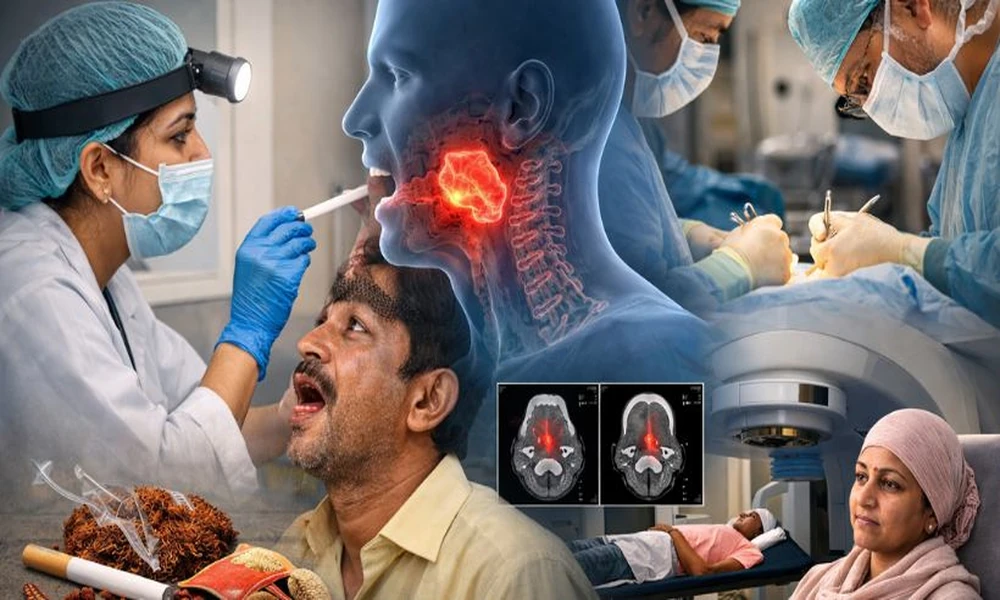
Most people do not know who to see for a mouth ulcer that will not heal, a hoarse voice that has lasted a month, or a painless lump in the neck. These complaints usually turn out to be harmless, but each can also be the first sign of a head and neck cancer, a group of cancers that India carries an unusually high burden of because of tobacco, areca nut and alcohol use. This article explains the warning signs, what a head and neck cancer doctor does, and what to expect from diagnosis through recovery.
What counts as head and neck cancer?
The term covers cancers of the mouth, tongue, lips, throat (oropharynx and hypopharynx), voice box (larynx), nose and sinuses, salivary glands such as the parotid, and the thyroid gland. Most are squamous cell carcinomas arising from the lining of these areas, and together they account for roughly a quarter to a third of all cancers in Indian men.
Warning signs that need a specialist opinion
See a doctor without delay if any of these lasts more than three weeks:
- An ulcer, red or white patch, or lump in the mouth or on the tongue.
- A lump or swelling in the neck, especially if painless and growing.
- Persistent hoarseness or a change in voice.
- Pain or difficulty swallowing, or a feeling of food sticking.
- Difficulty opening the mouth fully (trismus).
- A blocked nose on one side, nosebleeds, or facial numbness.
- Ear pain on one side without an ear infection.
- Loose teeth with no dental explanation.
- Unexplained weight loss.
Tobacco users in any form – cigarettes, bidi, gutkha, khaini, paan with tobacco – and regular alcohol users are at the highest risk and should take these signs and symptoms of head and neck cancer seriously. HPV-related throat cancers also occur in non-smokers, so do not dismiss symptoms because you have no habits.
Who is the right doctor?
Head and neck cancer care involves a team, but the person who usually leads diagnosis and treatment planning is a surgical oncologist trained in head and neck surgery (MS followed by MCh or DNB in surgical oncology, or a head and neck fellowship). A head and neck surgeon of this kind evaluates the tumour, arranges staging, performs the operation and reconstruction, and coordinates with the radiation and medical oncologists. Ideally the whole team – including the radiologist, pathologist, dental oncologist, speech-swallow therapist and dietitian – meets as a tumour board to agree on a plan.
Your first point of contact may be a dentist, family physician or ENT surgeon. Ask for a referral to a cancer surgeon once there is a suspicion of malignancy, rather than waiting for repeated courses of antibiotics or mouthwash to work.
Diagnosis: the steps
- Clinical examination of the mouth, throat and neck, often with a flexible endoscope passed through the nose to view the larynx and pharynx.
- Biopsy of the suspicious area, or FNAC of a neck lump, to confirm the diagnosis and type of cancer.
- Imaging: CT or MRI to assess the extent of the tumour, bone involvement and lymph nodes; PET-CT for advanced disease or to look for distant spread.
- Dental and nutritional assessment before treatment, since radiation affects the teeth and swallowing.
- Staging using the TNM system (tumour size, nodes, metastasis), which determines the treatment plan.
Most of this can be completed within one to two weeks.
Treatment options
Treatment depends on the site and stage:
- Surgery: the main treatment for most oral cavity cancers and many laryngeal and salivary gland cancers. The tumour is removed with a margin of healthy tissue, often with a neck dissection to clear lymph nodes. Reconstruction using tissue from the forearm, thigh or leg (free flaps) restores form and function in the same operation.
- Radiation therapy: used alone for some early throat and larynx cancers, or after surgery when the tumour was large or nodes were involved. Modern radiation therapy for head and neck cancer uses IMRT to spare the salivary glands and spinal cord.
- Chemotherapy: usually given with radiation (chemoradiation) for locally advanced disease, or before surgery in selected cases to shrink the tumour.
- Targeted therapy and immunotherapy: for recurrent or metastatic disease, decided by the medical oncologist.
Costs vary considerably: indicatively ₹2-5 lakh for early-stage single-modality treatment and ₹8-18 lakh for multimodal treatment in private metro hospitals, far less in government centres and often covered under Ayushman Bharat or state schemes. Exact figures come from the treating hospital.
Recovery and rehabilitation
Recovery is not only about the wound healing. Depending on the treatment, patients may need:
- Swallowing therapy, with a feeding tube used temporarily in some cases.
- Speech therapy, including voice prosthesis training after laryngectomy.
- Physiotherapy for shoulder stiffness after neck dissection.
- Dental care and jaw exercises to prevent radiation-related decay and trismus.
- Nutrition support, as weight loss during radiation is common.
- Tobacco and alcohol cessation, which lowers the risk of a second cancer.
Follow-up visits are usually every two to three months in the first two years, when most recurrences occur, so keeping these appointments matters.
When to seek emergency care
Go to a hospital immediately for breathing difficulty or noisy breathing, heavy bleeding from the mouth or nose, an inability to swallow even saliva, or high fever with neck swelling after treatment.
Early presentation to a head and neck cancer doctor is the single most important factor you control. A three-week rule – any mouth, throat or neck symptom persisting beyond three weeks gets examined – is a sensible habit for everyone, especially tobacco users.
Disclaimer: This article is for general information only and is not a substitute for medical advice. Please consult a qualified doctor about any persistent mouth, throat or neck symptom.
