
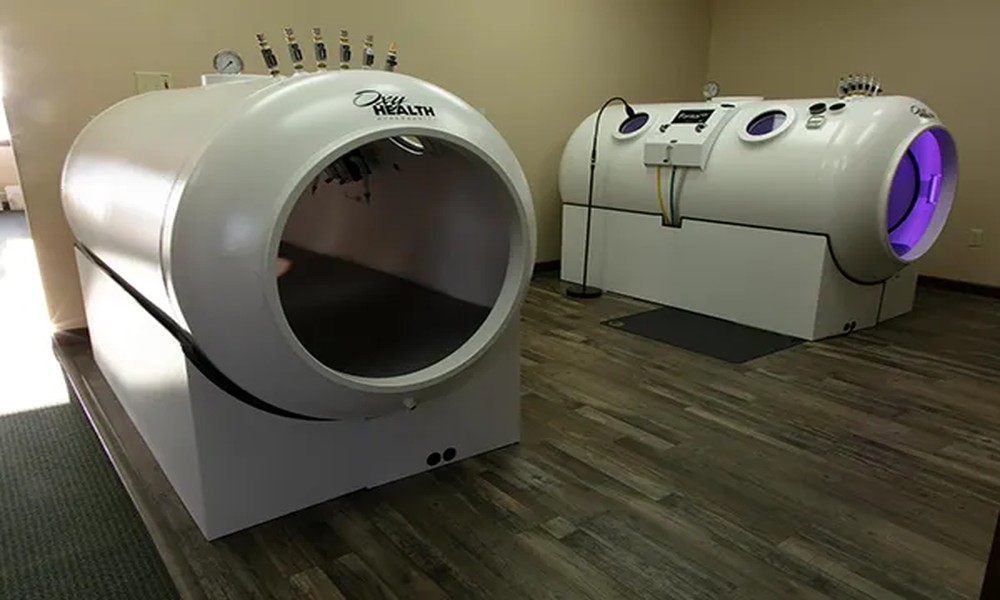
Most people expect to find a hyperbaric chamber in a hospital, a wound care clinic, or maybe a specialty sports medicine practice. Finding one inside a chiropractic office surprises some patients on the first visit. The reason a chamber sits next to the NUCCA suite and the DRX9000 at Draper Spinal Care is straightforward: tissues recovering from spinal correction, decompression, injury, or surgery heal faster when they have access to more oxygen, and a hyperbaric chamber is the only way to substantially increase how much oxygen reaches them.
Hyperbaric oxygen therapy, or HBOT, is not a new technology. It has been used in hospital medicine for decades, primarily for conditions like decompression sickness, carbon monoxide poisoning, and non-healing wounds. The application to chiropractic recovery and general healing support is more recent, and the reasoning behind it makes biological sense.
How HBOT Works at the Tissue Level
Under normal atmospheric pressure, the oxygen you breathe is carried almost entirely by hemoglobin in your red blood cells. The plasma carries very little dissolved oxygen because gas dissolves into a liquid in proportion to the pressure around it. This is Henry’s Law, the same principle behind the bubbles in a sealed bottle of soda.
Inside a hyperbaric chamber, the surrounding pressure rises. When you breathe oxygen at that elevated pressure, the plasma in your blood can carry significantly more dissolved oxygen than it normally does. That oxygen reaches tissues that hemoglobin alone struggles to supply, including poorly vascularized structures like spinal discs, tendons, ligaments, and the deep layers of healing scar tissue. Higher tissue oxygen levels reduce inflammation, support fibroblast activity and collagen production, encourage the formation of new capillaries, and create conditions where stem cells move more readily to areas of injury.
The effect is not a stimulant. It is a saturation. You are giving the body more raw material for repair processes it was already trying to run.
Hard Chambers and Mild Chambers Are Not the Same
There are two categories of HBOT worth understanding. Hard hyperbaric chambers operate at pressures of 2.0 to 3.0 atmospheres absolute and deliver 100 percent oxygen. These are the FDA-approved hospital chambers used for the conditions named above. Mild hyperbaric chambers, often soft-sided, operate at 1.3 to 1.5 atmospheres and use concentrated oxygen delivered through a mask. Mild HBOT is what most wellness and chiropractic practices offer, and the literature on its effects for recovery, sports performance, and chronic conditions is growing but smaller than the hospital research.
Patients should ask any clinic whether the chamber is hard or mild, and what pressures are used. Both have their place. The two are not interchangeable.
Why HBOT Pairs Well With Chiropractic Care
The connection between hyperbaric oxygen and chiropractic recovery is not theoretical. Three points of overlap show up in practice.
Spinal discs are avascular, meaning they have no direct blood supply and depend on diffusion to take in nutrients and oxygen. Patients on a DRX9000 spinal decompression protocol are working to rehydrate and retract injured disc material. Higher oxygen perfusion in the surrounding tissue supports that process.
Nerves recovering from compression, whether from a herniated disc, a postural pattern corrected through NUCCA care, or a past whiplash injury, regenerate slowly and benefit from oxygen-rich tissue conditions. The same is true of the small muscles around the cranio-cervical junction that often stay chronically tight in upper cervical patients.
Inflammation responds to oxygenation as well. When tissue inflammation is lower, NUCCA corrections often hold longer, decompression sessions are more comfortable, and the body is less reactive overall.
Conditions That Often Bring Patients to HBOT
Patients commonly add hyperbaric sessions to their care plan for:
- Recovery from herniated disc or sciatica treatment
- Post-concussion symptoms and persistent effects of head injury
- Soft tissue injuries from athletics, falls, or motor vehicle accidents
- Surgical recovery, including post-fusion or post-arthroscopy
- Chronic inflammatory conditions and slow-healing wounds
- General fatigue and recovery support during a demanding training season
These are adjunctive uses. HBOT is not a stand-alone treatment for most of them, and reasonable practitioners frame it as part of a broader plan rather than a cure for any single condition.
What a Session at Draper Spinal Care Looks Like
A session runs about 60 to 90 minutes. You lie down in the chamber, fully clothed, and the pressure rises gradually over the first several minutes. You will feel mild pressure in your ears similar to landing in an airplane, and you equalize the same way: swallowing, yawning, or a gentle Valsalva. Once at target pressure, you breathe enriched oxygen and rest. Most patients read, listen to music, or fall asleep. Pressure releases gradually at the end. There is no pain, no needles, and no medication involved.
Who Is and Isn’t a Candidate
Hyperbaric oxygen therapy is well tolerated by most people, but it is not for everyone. Contraindications include untreated pneumothorax, certain chemotherapy agents, severe untreated COPD with carbon dioxide retention, and recent middle ear or sinus surgery. Patients with claustrophobia, uncontrolled seizures, or active upper respiratory infections need a careful intake before scheduling. A short consultation determines whether HBOT is appropriate for your situation and how to integrate it with the rest of your chiropractic care.
Adding HBOT to Your Care Plan
If you are already a NUCCA or decompression patient, or you are weighing chiropractic care for an injury or chronic condition, hyperbaric oxygen therapy may speed and deepen the results you are aiming for. Draper Spinal Care offers a consultation to discuss whether HBOT fits with the rest of your care, what protocol length makes sense, and how it can integrate with NUCCA correction or DRX9000 decompression. The conversation costs nothing, and the science is worth knowing about even if you decide it is not the right tool for you right now.
